UNDERSTAND THE TOOLS / MABASA GUIDES
How to choose a job aggregator for a search from Zimbabwe
Compare unified job-search tools by source coverage, account requirements, original adverts, remote eligibility and tracking features, with Mabasa’s limits explained.
THE SHORT ANSWER
Choose a job aggregator that lets you search relevant sources, inspect original adverts and understand where the application happens. For a search from Zimbabwe, verify local coverage and remote-country eligibility separately. Free browsing, tracking and CV tools can help, but they do not remove an employer’s requirements or guarantee hiring outcomes.
Understand what a unified job search actually does
A job aggregator gathers opportunities from more than one source into a searchable catalogue. A job board usually publishes or hosts its own listings. A unified workspace can also include a shortlist, application record and CV tools. Those are different capabilities, so compare the complete workflow rather than the product label.
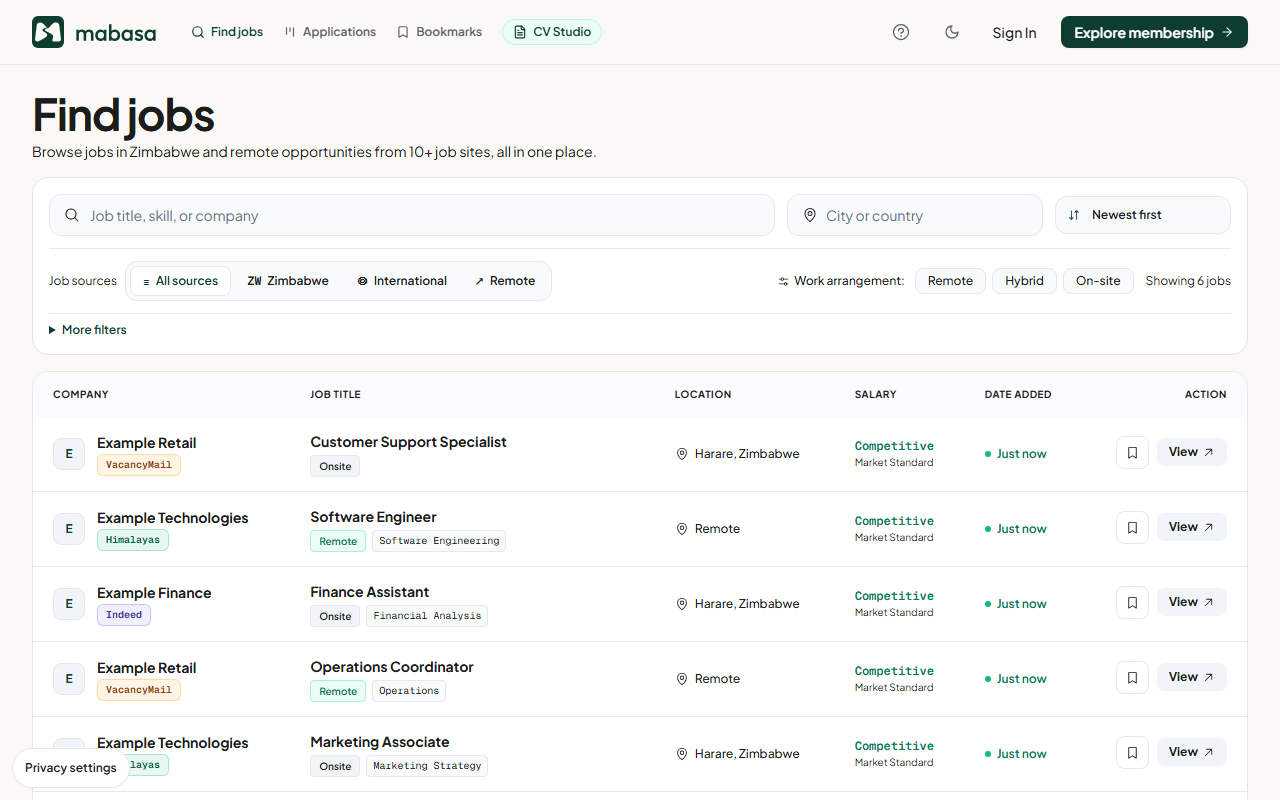
Mabasa combines listings from external sources with free application tracking and a manual CV builder. It is built in Zimbabwe and provides local and international discovery. This guide is published by Mabasa to explain those choices; it is not an independent ranking of competing platforms.
Check Zimbabwe coverage before counting sources
A large global catalogue is not necessarily useful for a local search. Look for vacancies in places you can work, such as Harare or Bulawayo, then inspect the original adverts. A source count does not tell you how many distinct, current and suitable jobs exist for your circumstances.
For international opportunities, check whether the source includes remote roles and whether their country restrictions are visible. A remote role may still be limited to another country. Mabasa’s remote collection is a discovery list; it does not certify that every result accepts applicants living in Zimbabwe.
- Relevant roles and locations appear in the catalogue.
- Each result identifies its source and links to the original advert.
- The source publication date is distinguished from the date the aggregator found it.
- Missing salary, employer or deadline details are acknowledged rather than invented.
Separate free browsing from the employer’s application
Searching without an account reduces friction at the discovery stage. It does not mean every vacancy can be applied to without registration. An employer’s portal may require an account, a form or documents that the aggregator cannot submit for you.
Mabasa’s public catalogue, guest tracker and manual CV builder do not require a Mabasa account. You follow the original advert to apply. Paid membership adds AI career assistance; it does not turn the service into an automatic application agent.
Compare the work after you find a promising role
A useful discovery tool should help you reach a decision: read the details, check eligibility and prepare the correct documents. A workspace may also let you save the role and record an application. Check which features are free and whether they actually fit your routine.
In Mabasa, guest bookmarks, application records and CV drafts stay in the browser. That keeps the public tools available without an account, but it also means you need backups. Clearing storage or switching devices can remove access. PDF generation uses server processing, while paid AI processes the information you submit.
- Search the Zimbabwe catalogue or a relevant city collection.
- Read the source advert and confirm that the vacancy is still open.
- Save an interesting role, then prepare a truthful CV for it.
- Apply through the original channel and keep the confirmation.
- Update Applications and back up important records.
Treat matching and duplicate handling as assistance
An aggregator can make repeated searching easier, but it cannot guarantee every advert is genuine, every duplicate is removed or every vacancy remains open. Check the same employer, title and reference before resubmitting an application.
Paid job matching can help you compare career evidence with requirements. A fit score is not an employer’s screening score, a probability of being hired or proof that the employer is legitimate. Review the underlying information and the current plan limits before paying for assistance.
Test one complete application workflow
Before choosing a paid tool, try the free workflow on one role. Can you find a relevant advert, understand its origin, inspect the full requirements and keep a clear record of what you did? That small test is more informative than an unsupported claim that a service is the best.
Use Mabasa’s public catalogue and free tools if that workflow suits you. Review pricing for the optional AI features, and read the privacy policy for the distinction between local drafts and server processing. Employers still decide who to interview and hire.
Sources & product details
- Mabasa’s public job catalogue ↗
Current discovery pages and links to original adverts.
- Mabasa free and paid capabilities ↗
What the product offers and its stated limits.
- Mabasa privacy policy ↗
Browser storage, PDF processing and optional AI tools.
Product instructions reflect the implementation reviewed on 22 October 2026. Example screenshots may differ from your device or a later release. This guide is prepared by Mabasa; external sources do not endorse the product.